
Choose a meteor-shower viewing window by starting with current shower guidance, then finding the overlap with local darkness, a usable radiant position, acceptable moonlight, promising cloud conditions, and permitted access. Plan arrival and setup separately. The result is a candidate observing opportunity; it does not predict how many meteors you will see or photograph.
Start with activity, not a clock time
Look up the named shower in a current primary astronomy source. Record the activity dates, expected peak, radiant information, and year. An activity period and a peak night answer different questions: whether the shower is active, and when stronger activity is expected. Neither alone says when your particular site has a dark, usable sky.
If a source gives a precise time in UTC, convert both the time and the calendar date to your observing location. If it gives only a peak night, keep that level of precision. Label an overnight session with both dates, such as “evening October 21 into morning October 22,” rather than leaving an ambiguous “October 22” in the plan.
The American Meteor Society's meteor FAQ explains that maxima can be sharp or broad, can occur during local daylight, and can vary from the prediction. Consider nearby active nights when comparing your options.
Check the radiant and the open sky
The radiant is the point from which shower trails appear to spread. It helps you evaluate the shower's position through the night; it is not the physical source of the meteors or a tiny viewing target. NASA's Orionids guide explains that meteors can appear across the sky and that trails seen near the radiant look shorter because of perspective.
Check where the named shower's radiant will be from your location during the proposed session. Then inspect how much sky is open from the actual observing position. Trees, buildings, and nearby lights can make an otherwise promising time less useful. A spot with one narrow gap is a different proposition from an open view.
Do not turn a familiar rule such as “after midnight” into a universal appointment. NASA recommends those hours for the Orionids, but another shower, latitude, or local horizon needs its own check. There is no single radiant-height cutoff in this worksheet.
Build the local window
Put all times on the same local date and time zone. Keep a note of which entries are astronomy calculations, weather forecasts, or personal constraints.
- Darkness: record the part of the night you want to use. Check the approach of dawn as well as the start of darkness; the twilight guide explains the distinction.
- Radiant and view: mark when the shower's radiant has a useful position for this site, with a broad view available.
- Moon: record local moonrise or moonset and choose whether moonlit hours are acceptable for your goal. A bright Moon can conceal faint meteors while brighter ones remain visible. Use the Moon planning guide to look beyond phase alone.
- Cloud: mark the promising forecast periods, including uncertainty. Recheck before departure and on arrival; an hourly forecast is not a guarantee of uninterrupted clear sky.
- Access and availability: check permission, opening hours, arrival, setup, and your departure deadline. Use the hours you can actually watch, rather than the full time away from home.
Reserve time for eye adjustment and avoid bright screens. The AMS recommends a broad unaided view; binoculars and telescopes restrict the sky you can watch.
A hypothetical 70-minute overlap
These invented intervals illustrate the method. They are not an Orionid forecast, a real location's ephemeris, or measurements from a field test. All times below fall on the same hypothetical local morning, with no clock change.
| Constraint | Candidate interval |
|---|---|
| Dark portion of the night being considered | 00:30–05:30 |
| Radiant position judged usable for this site and goal | 02:00–05:30 |
| Chosen Moon-below-horizon period | 03:10–05:30 |
| Promising cloud-forecast interval | 02:40–04:20 |
| Available on-site time after arrival and setup | 02:30–05:00 |
The latest start is 03:10. The earliest finish is 04:20. Their overlap is 1 hour 10 minutes, or 70 minutes.
That is the candidate overlap, not a promised length of clear viewing. If eye adjustment, camera checks, or interruptions happen inside it, they use some of those minutes. Travel and setup belong in the full trip budget, outside this calculation where possible. Do not multiply the interval by a headline hourly rate to promise a count.
Now change just one assumption: suppose the promising cloud period ends at 03:00. It no longer overlaps the chosen Moon-below-horizon period starting at 03:10. You could accept an earlier moonlit session, compare another active night, or cancel. The worksheet should make that tradeoff visible rather than silently combining incompatible hours.
Decide when the conditions disagree
| What you find | What to do with the plan |
|---|---|
| The peak night is moonlit; a darker period comes later | Compare the later period with the remaining darkness, radiant position, clouds, and access. Moonset alone does not complete the plan. |
| The forecast is clear earlier, before your preferred darker hours | Decide whether a moonlit attempt fits your goal. Record that compromise, or compare a different active night. |
| The nominal activity peak falls outside your local night | Compare the adjacent local-night opportunities using current shower guidance. Do not invent a new exact peak time. |
| Your preferred site closes before the overlap begins | Choose a permitted alternative with a checked view, or move the session. A dark map pin does not grant access. |
| The window is short and camera setup consumes most of it | Prioritize watching, simplify the equipment, or budget another outing. Treat photographs as an uncertain extra if that suits your goal. |
A dated note: the 2026 Orionids
NASA's October 2026 skywatching update identifies the night of October 21 into the morning of October 22 for the Orionid peak. It warns that a bright waxing gibbous Moon will hide some faint meteors and suggests a possible opportunity before dawn after moonset.
Check local moonset, dawn, radiant position, clouds, and access before choosing those hours. This is a dated example of the workflow, not a universal 2 a.m. start or a precise UTC maximum. Use current annual guidance when planning a later year's shower.
Watching and photographing are different plans
For visual watching, choose a comfortable position that lets you follow a broad area of sky. The AMS explains ZHR as an idealized rate for dark, clear skies with the radiant overhead. Moonlight, clouds, light pollution, and radiant height change actual counts; activity is also uneven. That standardized number is not your personal hourly forecast.
For photography, budget time to secure the camera, choose the frame, check focus, and take test images. NASA's meteor-photography guide recommends wide-angle coverage and stable support, and stresses the uncertainty of capturing a meteor. Its advice targets DSLR, mirrorless, and suitable manual cameras; its old calendar is not the source for the 2026 dates above.
A meteor you see outside the camera's frame, or while it is not exposing, will not appear in that photograph. Device capability and settings matter too. If you are using an iPhone, test its actual camera controls with the iPhone night-sky photography guide; a successful star image does not guarantee a meteor capture. Keep an enjoyable visual session as a valid outcome if photographs are optional.
Copy the session worksheet
Fill this in before departure, then revise the forecast-dependent parts when you check conditions again.
- Shower and year: name, primary source link, and date checked.
- Activity and expected peak: preserve the source's precision; note its time zone and your local conversion if a time is supplied.
- Observing site: exact setup position, open-sky directions, permission, and access hours.
- Local-night dates and time zone: write both dates for an overnight session.
- Candidate intervals: darkness, radiant position, chosen Moon conditions, cloud outlook, and on-site availability.
- Overlap: latest start, earliest finish, duration, and the assumption most likely to change.
- Session goal: watching, photography, or both; arrival, eye-adjustment, and equipment time.
- Fallback: an acceptable moonlit period, another checked site or active night, or a reason to stay home.
- Field notes afterward: actual start and finish, interruptions, sky conditions, and what to change next time. Keep observed results separate from forecast expectations.
Before leaving, confirm that the selected hours still overlap, access is permitted, and the journey fits your return deadline. On arrival, reassess the sky before committing to the original schedule.
Bring the conditions together
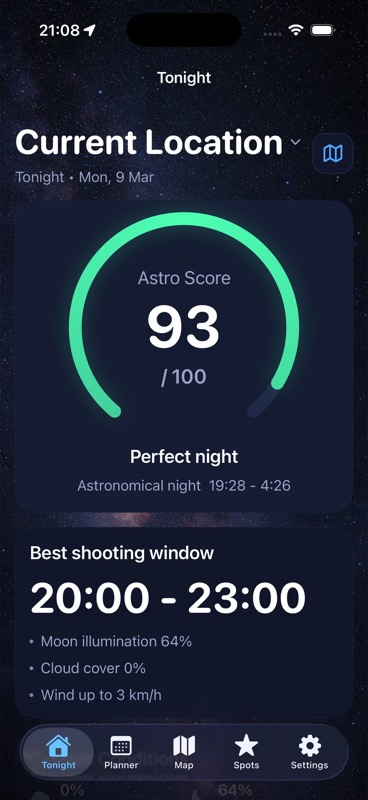
Use DarkScout for the general planning context: cloud and Moon conditions, darkness, saved observing spots, and comparing nights within its 14-night planner. Keep the shower's activity dates and radiant guidance beside that plan using a current astronomy source. A general conditions score or planning window is not a prediction of meteor counts, and photographs are taken through your camera.
The current App Store listing describes DarkScout's free planning features. It requires iOS 26 or later. The worksheet above is also usable on its own.
Keep the night plan close.
Compare clouds, Moon conditions, and saved observing spots before choosing your meteor-watching session.
Get DarkScout for iPhone All features free · iOS 26 or laterSources and further reading
- NASA: October 2026 skywatching tips — the dated Orionid peak-night and Moon guidance.
- NASA: Orionids — radiant, perspective, and shower-specific viewing advice.
- American Meteor Society: Meteor FAQ — peak uncertainty, visual observing, and the meaning of ZHR.
- NASA: How to Photograph a Meteor Shower — camera workflow and capture limitations, rather than current-year calendar dates.