Many astrophotography plans begin with the same shortcut: wait for a new moon. That advice is useful for faint targets, but it is incomplete. The moon changes the sky in ways that depend on phase, altitude, timing, direction, haze, and what you are trying to photograph.
A better question is: will the moon be adding useful light, harmless light, or damaging light during the part of the night that matters?
Why moon phase is only the first clue
Moon phase tells you how much of the moon is illuminated, but it does not tell you whether the moon is above the horizon while you shoot. A bright moon that sets before astronomical darkness may not affect the main session. A smaller moon that rises directly into your target window can matter a lot.
Treat phase as the headline and moonrise, moonset, altitude, and direction as the details. The details are what decide the plan.
New moon is best for faint sky contrast
If your goal is the Milky Way core, faint nebulae, dust lanes, or low-contrast galaxies, the darkest nights are usually strongest. Around new moon, the sky background is darker, gradients are easier to manage, and faint structure survives better through capture and processing.
New moon does not guarantee a good session. Clouds, haze, smoke, poor transparency, low target altitude, and local light pollution can still ruin the night. It simply removes one major source of skyglow.
Quarter and crescent moons can be useful
A crescent or quarter moon can be helpful for landscape astrophotography. Low moonlight can illuminate a foreground naturally, especially when you want detail in mountains, trees, buildings, or a person in the frame. The trick is balance. Too much moonlight makes the sky pale. Too little leaves the foreground completely dark unless you light paint or blend exposures.
For Milky Way landscapes, a moon that is low, behind you, or outside the main dark window can sometimes create a more complete image than a moonless night. For deep sky imaging, the same moon may be a problem if it sits near the target or brightens the background enough to reduce contrast.
Full moon is not useless
Full moon is usually poor for faint deep sky work and Milky Way contrast, but it is not useless. It is a strong time for moon photography, night landscapes with moonlit foregrounds, star trails with visible terrain, scouting locations, testing gear, and practicing polar alignment or workflow.
If you only shoot faint objects, full moon may be a maintenance window. If you shoot night landscapes, it can be a creative light source.
Moon distance from the target matters
The moon does not need to be inside your frame to affect the image. Bright moonlight scatters through the atmosphere and raises the sky background. The closer the moon is to your target, the more likely you are to fight gradients, lower contrast, and washed-out faint detail.
This is especially important for galaxies, nebulae, and dark nebula regions. A target high in the sky and far from the moon may still be workable under moderate moonlight. A target near the moon can become a poor use of a clear night.
Moon altitude changes the effect
A moon just above the horizon may be blocked by terrain or softened by atmosphere. A high moon lights the sky more evenly and can be harder to avoid. Direction matters too. A low moon behind your camera may help a foreground. A high moon near the subject may flatten the sky.
When planning, compare the moon's altitude and direction with your camera direction, foreground, and target path. This is where a basic phase calendar stops being enough.
A simple moon planning rule
For faint deep sky and high-contrast Milky Way work, prefer moonless hours or hours when the moon is below the horizon. For landscapes, decide whether moonlight helps the foreground more than it hurts the sky. For lunar images, optimize for moon altitude, seeing, and composition instead of darkness.
Do not ask only "what is the moon phase?" Ask "is the moon up during my best target window, where is it relative to my subject, and is that light useful or harmful?"
Where DarkScout fits
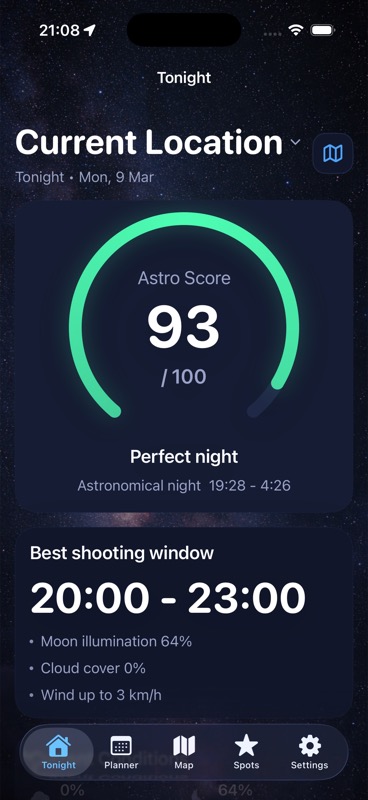
DarkScout surfaces moon impact inside the broader night decision. Instead of checking phase in one place, weather in another, and target timing somewhere else, you can read the moon as part of the same planning window. That is the difference between knowing the moon phase and knowing whether the moon changes your plan.