
Astronomical darkness and nautical twilight describe how far the sun sits below the horizon. They sound technical, but for night photography they answer a very practical question: has the sky finished getting darker for the kind of image you want to make?
Nautical twilight can still leave a faint glow in the sky, especially toward the sun's direction. Astronomical darkness begins when that glow is low enough that most astrophotography plans can treat the night as fully dark. The exact choice matters because many sessions have only a short overlap between darkness, moon position, subject altitude, clouds, and your available time.
The short version
Use nautical twilight for scouting, foreground frames, blue-hour blends, bright constellations, moonlit landscapes, and setup time. Wait for astronomical darkness when you care about faint Milky Way detail, nebula contrast, galaxies, clean star fields, or long tracked integrations.
That does not mean every good image starts at astronomical darkness. It means the deeper the subject and the lower the contrast, the more expensive twilight becomes. If the goal is a clean Milky Way core or a faint deep sky target, the useful window usually starts later than "it looks dark outside."
What nautical twilight is good for
Nautical twilight can be valuable because it gives shape to the land. Foregrounds still have separation, the horizon is easier to read, and you can build a stronger composition before the sky becomes fully black. For wide night landscapes, that can be an advantage instead of a compromise.
This is also a smart setup window. You can walk the location, confirm where the target will rise, check tripod placement, and shoot foreground plates while you still have enough ambient light to work safely. If you are testing a new spot, nautical twilight is often when you discover whether the horizon, access, and composition actually match the plan you made at home.
Where nautical twilight starts to hurt
The problem with twilight is contrast. The sky background stays brighter than it will be during astronomical darkness, so faint structure has less room to separate from the glow. Stars still appear, but dim dust lanes, weak nebulosity, and galaxy arms can get buried in a brighter background.
Direction matters too. The part of the sky opposite the sun may become usable earlier than the western horizon after sunset, or earlier than the eastern horizon before sunrise. If your Milky Way composition points into the twilight glow, waiting can improve the files more than changing camera settings will.
What astronomical darkness changes
Astronomical darkness is the point where the sun's leftover glow is no longer the main thing limiting faint sky contrast. Light pollution, moonlight, haze, and clouds can still ruin a session, but twilight is no longer adding its own penalty.
For Milky Way work, astronomical darkness gives the core and dust lanes their best separation. For deep sky imaging, it protects integration time. A two-hour target window is not really two hours if the first half is spent fighting a brightening sky. This is why a good deep sky target window should include darkness quality, not only whether the object is above the horizon.
The moon can matter more than twilight
Do not treat astronomical darkness as a guarantee. A bright moon can erase much of the advantage by raising the sky background after twilight ends. Thin cloud or haze makes this worse because it scatters moonlight across the frame.
On moonlit nights, the better choice may be a subject that uses the light: a foreground landscape, moonrise, star trails, or location scouting. On moonless nights, the astronomical-darkness window is more precious because faint subjects finally get the cleaner sky they need. The moon phase planning guide covers that tradeoff in more detail.
Milky Way planning depends on the season
Twilight is especially important for Milky Way planning because the core does not stay in the same place all year. In some months it rises before the night reaches full darkness. In others it sits best after midnight, when twilight is irrelevant but moon timing and clouds become the bigger constraints.
If the core is low during twilight, decide what you actually want. A blue-hour Milky Way hint over a strong foreground can be a good photograph. A detailed core panorama usually needs patience. Compare core position, moon impact, cloud timing, and the strongest dark interval before committing to the drive. That same overlap logic is central to a practical Milky Way planning guide.
A practical twilight decision checklist
Before a session, separate the night into three windows. First, use nautical twilight for arrival, scouting, foregrounds, and setup. Second, protect astronomical darkness for the faintest or most important sky frames. Third, decide whether dawn twilight is worth using for a foreground, a final composition, or simply packing down before the site gets busy.
Then ask four questions. Is the subject bright or faint? Is the camera pointing toward the twilight glow? Is the moon adding more sky brightness than twilight would? Does the target's best altitude overlap with full darkness, or are you trying to force the shot too early?
If the image depends on faint contrast, wait for astronomical darkness. If the image depends on a strong foreground or a travel memory, nautical twilight may be part of the plan instead of a problem.
Where DarkScout fits
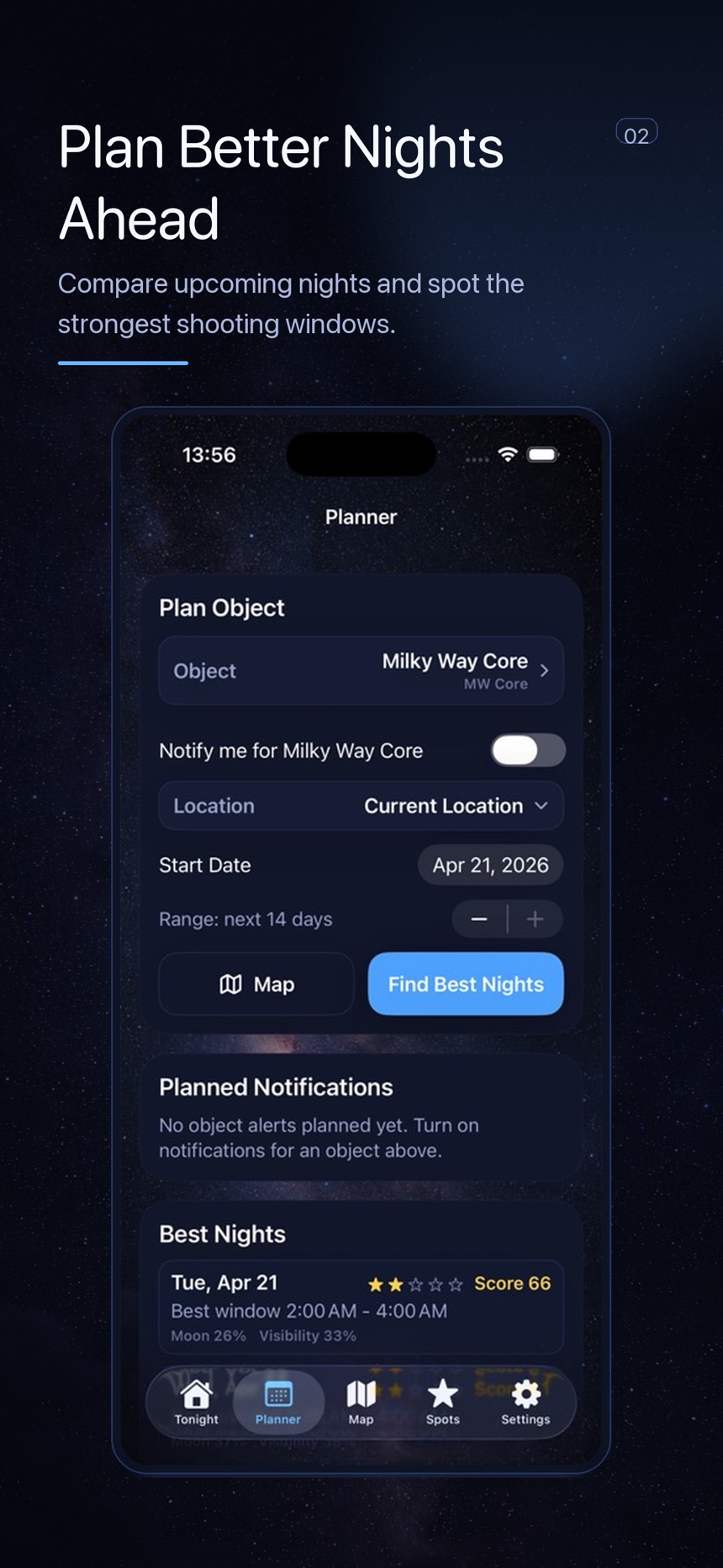
DarkScout is useful here because twilight is only one layer of the decision. The Planner and Tonight views help you compare the best shooting window with moon impact, cloud context, and the subject you intend to shoot, so you can avoid treating "dark" as a vague feeling.
The goal is not to wait for perfect nights. It is to spend the best part of each night on the work that deserves it: setup and foregrounds while the sky is still bright, serious sky frames when the contrast is strongest, and a cleaner no-go call when the overlap never really arrives.