
Plan a star-trail session by making two choices together: the composition you want to keep and the capture sequence your actual equipment can sustain. Check both before assigning the night a long uninterrupted run. A reference picture's settings or duration are not a substitute for that check.
This guide covers deliberate trails. For pinpoint phone photographs, use the iPhone night-sky guide. For the whole outing's travel and return deadline, use the session time budget.
Choose the apparent motion and direction
NASA's Vienna star-trail explanation connects circular trails with Earth's rotation and identifies Polaris as near the north celestial pole. For a northern pole-centered composition, locate that pole in an appropriate sky chart; Polaris is a nearby reference, not the exact center.
The corresponding southern reference is the south celestial pole. ESO's Paranal example shows apparent trails around it. Record the observing hemisphere and intended view rather than copying the pointing direction of a photograph from elsewhere.
Choose whether the pole belongs inside the frame or whether you want a different part of the trail pattern. Check the view with your actual lens and tripod position. Keep the intended sky area and foreground edges in the same composition record.
Give the foreground a job
Nikon's general star-trail guide emphasizes camera direction, foreground, stable support, focus, and test exposures. Decide whether the foreground should read as a silhouette or contain visible detail. Inspect a test frame for the picture you intend, including bright lights and unwanted edges.
Keep the camera position and framing reproducible. If you intend a separate foreground exposure or a composite, write that down before the sequence. Retain the original files and describe the method honestly when sharing the finished image.
Choose a capture method you can verify
Fujifilm's star-trail tutorial distinguishes a long exposure from a series of shorter exposures merged afterward. Choose a method that your equipment and processing workflow support. For a series, confirm how you will trigger repeated frames, save them, and combine them outside the planning app.
Nikon's D780 case study demonstrates an interval-timer series and a separately handled foreground. Its exposure choices and run length belong to that photographer's camera and scene. Use your camera's manual to establish supported controls and what its interval setting means.
Test the sequence, including its pauses
Run a short trial with the exact exposure, timer, file format, and processing settings you intend to use. Inspect the saved sequence and actual capture timing. Check whether the next frame starts when expected, whether any frames are missing, and whether the camera remains ready.
Fujifilm explains that its example's long-exposure noise reduction records a blank frame, interrupting sky capture and producing gaps. Nikon's D780 example uses different noise-reduction choices for foreground and stars. Check your model's behavior and test the chosen sequence; a blanket recommendation to enable or disable the feature is insufficient.
Include power and storage in the trial and run plan. Keep enough time to finish, save files, and pack before your return deadline. Choose the intended run length for your composition and tested setup; there is no duration promised here for a particular trail length or finished result.
Run the preparation checklist
- Define the picture. Save the view direction, intended trail pattern, foreground treatment, and frame edges.
- Confirm the setup. Record the camera, optic, support, focus, and supported capture method.
- Inspect a frame. Check the sky and foreground exposure before starting the main run.
- Test the sequence. Review actual files and pauses with the planned settings.
- Set the boundary. Keep a stop time, packing allowance, and an alternative if the run becomes unsuitable.
Choose an action from the check
| What you find | Next useful action |
|---|---|
| The intended direction or frame is uncertain | Check the sky reference and actual camera view before starting. |
| The foreground does not match the goal | Revise its treatment or composition, then inspect another test frame. |
| The sequence has unexplained pauses | Check the timer and processing behavior against the manual; repeat the trial. |
| The remaining window cannot support the chosen plan | Shorten or change the goal, choose another evening, or stop. |
| Conditions change during the run | Assess the actual frames and remaining plan; record any interruption before deciding to continue. |
Copy the star-trail worksheet
Use one record per composition. Mark uncertain items explicitly.
| Field | What to keep |
|---|---|
| Composition | Hemisphere, view direction, sky reference, frame edges, foreground goal, and any planned composite. |
| Equipment | Camera, optic, support, focus, capture method, and relevant manual reference. |
| Sequence | Exposure and timer settings, interval meaning, processing pauses, trial-file references, and observed timing. |
| Resources and window | Power/storage plan, conditions to watch, chosen start/stop, packing allowance, and fallback. |
| Outcome | Files retained, interruptions, what was actually checked, and changes for the next attempt. |
Match the run to a useful night
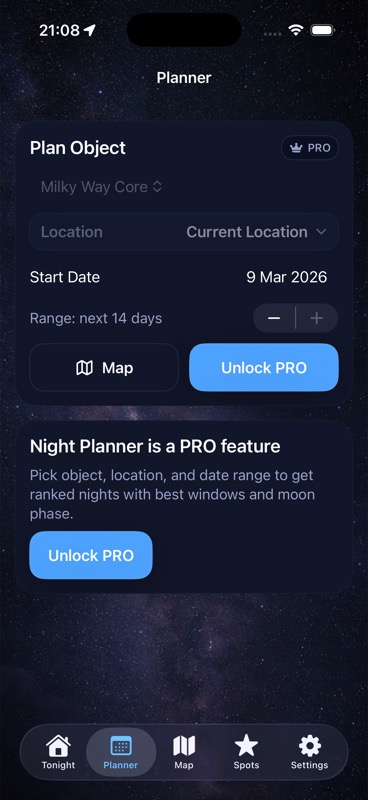
Use DarkScout for Moon and cloud context, night planning, and saved observing locations. Compare those conditions with the chosen run and keep your camera worksheet beside the plan. The Planner screenshot above is an example of night planning.
Check Moon timing, the local horizon, and cloud intervals for the intended view. Set up camera sequencing and image merging separately; a favorable night plan does not verify sequence continuity.
The current App Store listing describes the free iPhone app, requiring iOS 26 or later.
Find the night for your planned sequence.
Compare Moon, clouds, and a saved observing spot before setting up your camera.
Get DarkScout for iPhone All features free · iOS 26 or laterSources and further reading
- NASA: Star Trails Over Vienna — rotation and the northern pole reference.
- ESO: Star trails at Paranal — the southern pole reference.
- Nikon: Photographing the Night Sky—Star Trails — composition and preparation.
- Nikon: Star Trails with the D780 — a camera-specific sequence example.
- Fujifilm: How to Start Photographing Star Trails — capture methods and processing gaps.