A good astrophotography night is not just a clear night. Clear skies help, but a session can still fail because the moon rises during your best window, the target never gets high enough, wind makes long exposures soft, or your chosen spot has trees exactly where the subject climbs.
The useful question is simpler: is tonight good for this target, from this location, with this gear and effort level? Once you frame it that way, the go or no-go decision becomes much calmer.
Start with the shot, not the forecast
Before opening a weather app, name the session. A wide Milky Way landscape, a tracked deep sky object, a moon close-up, and a star trail image all want different conditions. A bright moon can ruin a faint nebula session but make a foreground landscape easier. Thin high cloud can be annoying for galaxies but harmless for a casual moon shot.
Your first filter should be intent. If the goal is faint detail, protect darkness and contrast. If the goal is a bright subject, protect stability and timing. If the goal is a landscape composition, protect direction, foreground access, and the usable window.
The six checks that matter most
1. Cloud cover at the exact hours you will shoot
A daily cloud percentage is too blunt. Astrophotography lives inside windows. You want to know whether the clouds are expected during astronomical darkness, during target culmination, or only before you set up. Low cloud can block the view completely. High cloud can soften stars and reduce contrast even when the sky looks mostly open.
2. Moon phase, moon altitude, and moon distance from your target
Moon phase alone is not enough. A 70 percent moon below the horizon during your target window may not matter. A small crescent close to your composition can matter more than expected. For deep sky work, distance between the moon and target matters because scattered light reduces contrast across the frame.
3. Darkness window
Civil, nautical, and astronomical twilight are not interchangeable. Many deep sky and Milky Way sessions benefit from astronomical darkness, when the sun is far enough below the horizon for the sky background to settle. In summer at high latitudes, that window can be short or absent. In winter, it can be long enough to make a mediocre evening worth using.
4. Target altitude and timing
A target just above the horizon is technically visible, but it may not be worth shooting. Low altitude means more atmosphere, more haze, more light pollution, and more local obstructions. A stronger window usually happens when the target is higher, ideally while the sky is dark and the moon is not interfering.
5. Wind, gusts, humidity, and dew risk
Sharp stars need physical stability. Wind can shake a tripod, flex a tracker, or turn a telephoto lens into a sail. Humidity and dew can end a session early unless you bring heaters or plan shorter runs. These are not always dealbreakers, but they change what gear and exposure strategy make sense.
6. The spot itself
A good forecast at a bad spot is still a bad plan. Check access, safety, parking, foreground direction, horizon obstructions, and whether nearby light sources point into the part of the sky you need. The best night score in the world does not help if the target is behind a ridge for the only two hours it is high.
What a good night looks like by subject
For Milky Way landscapes, prioritize a dark window, a moon that is down or low enough not to wash out the core, a foreground that faces the right direction, and enough clear time to compose. For galaxies and nebulae, prioritize astronomical darkness, target altitude, low cloud, low wind, and moon separation. For lunar photography, the moon itself becomes the subject, so seeing, altitude, and timing matter more than darkness.
This is why generic "clear sky tonight" advice can mislead you. The same night can be excellent for a crescent moon landscape, average for the Milky Way, and poor for a faint nebula. A useful plan judges the night against the shot.
A simple go or no-go rule
If you are deciding whether to drive, use this rule: go only when at least four things line up at the same time. You need a usable dark or subject-appropriate window, acceptable clouds, a target that is well placed, and a spot that gives you the view. If one factor is weak but manageable, adjust the plan. If two or more are weak, stay home or choose a lower-effort subject.
If clouds clear after midnight, the moon sets at 01:10, and your target peaks around 02:00, the night may be much better than the evening forecast looks. If the target peaks before the moon sets, the same conditions may be a poor fit.
Where DarkScout fits
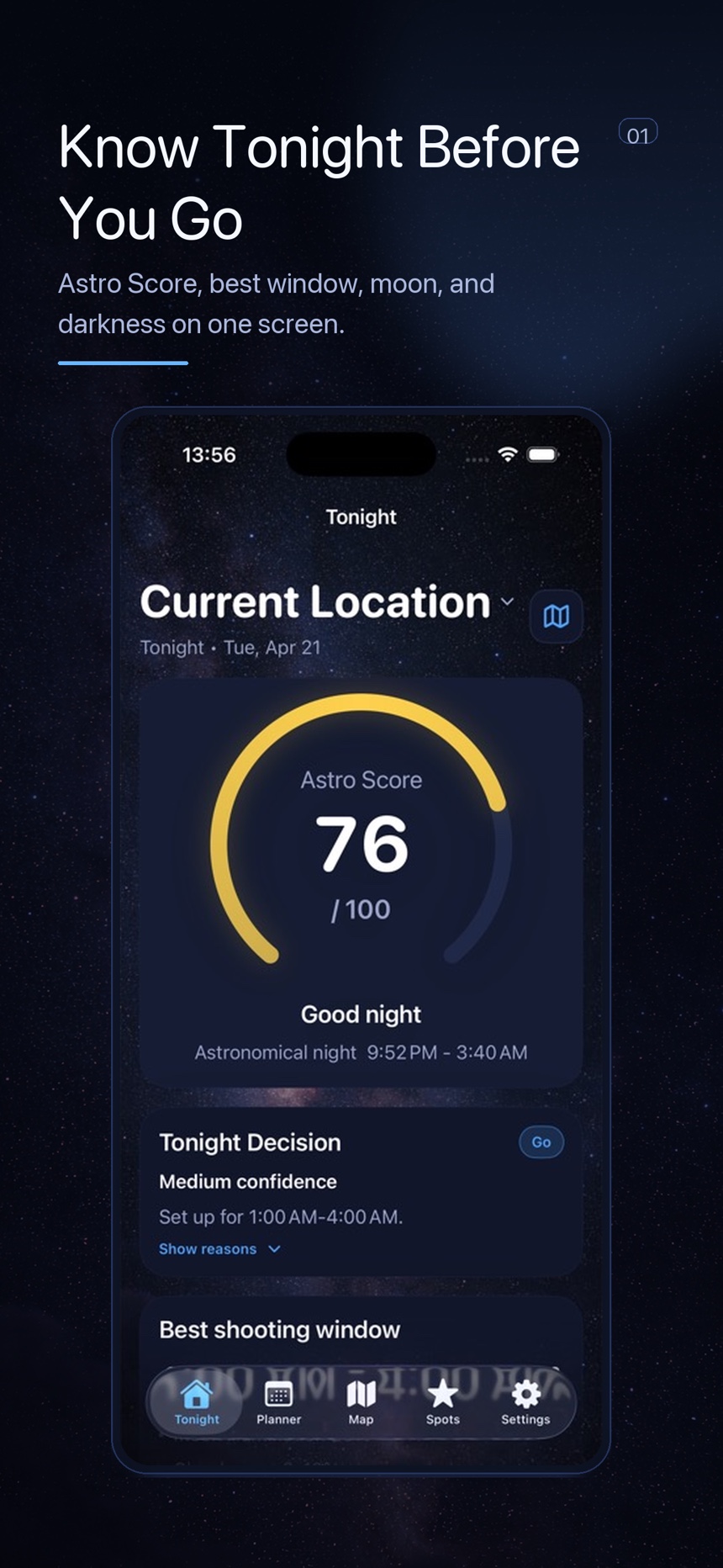
DarkScout is built around this combined decision. The Tonight view brings Astro Score, moon impact, cloud context, and the best shooting window into one place, while planning tools connect the target to the spot you intend to use. The goal is not to replace judgment. It is to get you to the right judgment faster, before the gear is already in the car.
A good astrophotography night is a match between sky, subject, spot, and effort. When those line up, the decision feels different. You stop checking five apps in a loop and start thinking about the image.