
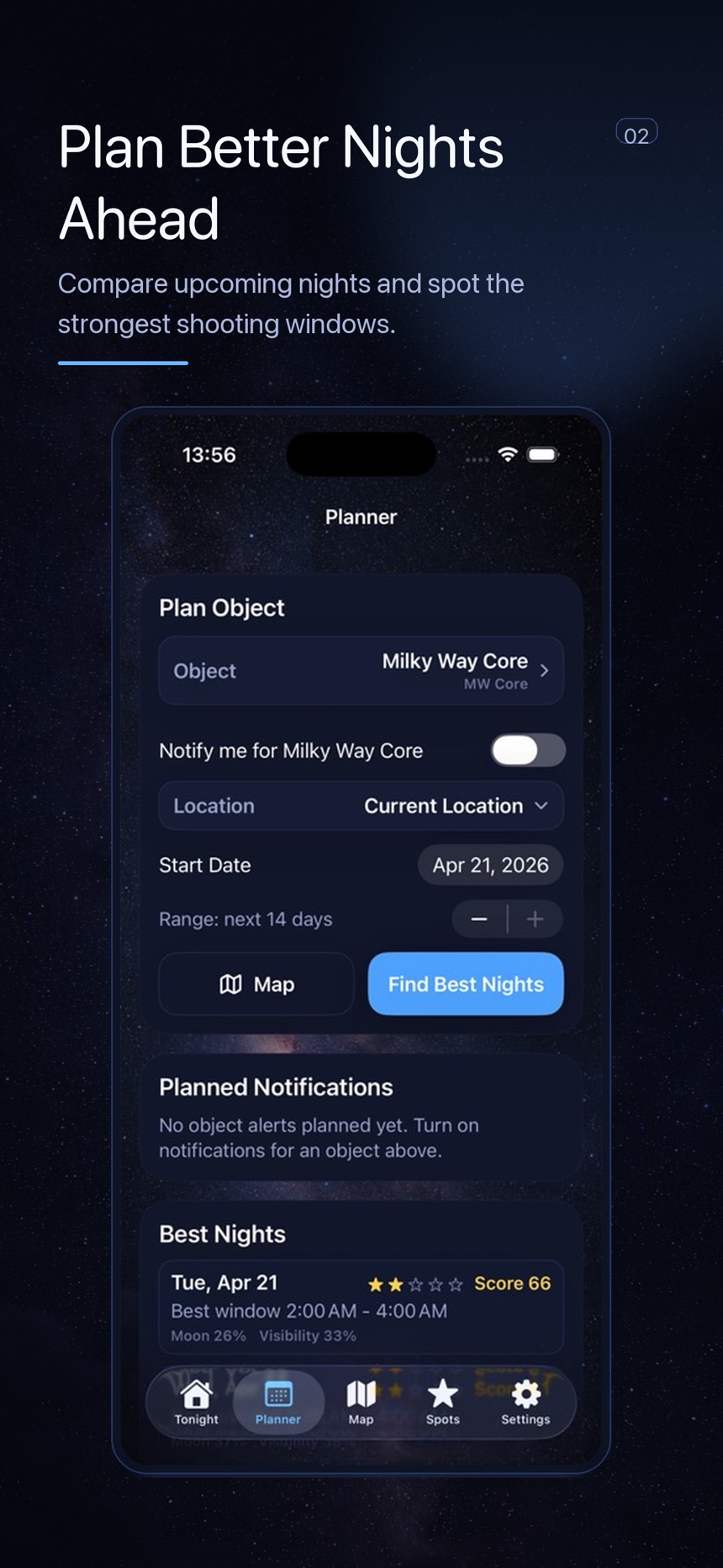
The Milky Way is easy to romanticize and easy to miss. You can have a clear night and still arrive too early, face the wrong direction, fight moonlight, or discover that your foreground blocks the galactic core. Good planning turns the session from a hopeful drive into a controlled window.
The core idea is simple: plan the Milky Way as an alignment problem. You need the right part of the sky, at the right time, above the right foreground, under a sky that is dark and clear enough.
Know what part of the Milky Way you want
Many people say "the Milky Way" when they mean the bright galactic core. The core is the dramatic region most often seen in landscape astrophotography, but it is not visible in the same way all year or from every latitude. Other Milky Way regions can still make strong images, especially with dark skies and a good foreground, but the planning changes.
Decide whether you are chasing the core, a panorama, a vertical arch, a star field, or a specific foreground alignment. That decision determines direction, timing, and lens choice.
Season sets the opportunity
Milky Way core visibility changes through the year. In many northern hemisphere locations, core season is strongest from spring through late summer, with the core appearing at different times of night as the season progresses. Early season often means pre-dawn sessions. Mid-season can bring more comfortable evening windows. Late season shifts the core earlier after sunset.
Season does not guarantee a shot. It only tells you whether the geometry is possible. The final plan still depends on moonlight, darkness, weather, and location.
Use astronomical darkness as your main window
For high-contrast Milky Way images, astronomical darkness is the safest planning target. The sky is darkest when the sun is far enough below the horizon and the moon is not brightening the scene. In some places and seasons, astronomical darkness may be short or missing, which means the Milky Way can be more difficult even on clear nights.
If the core is visible before astronomical darkness, you may still capture something, but contrast can be lower. If the best core alignment happens after the dark window ends, the image may need different expectations or a different date.
Plan around the moon with intention
New moon windows are the classic choice because they protect contrast. But a small or low moon can be useful when you want natural foreground light. The key is whether moonlight helps the image more than it hurts the sky.
If the moon rises after your core window, you may have a clean session. If it sets before the core climbs into position, the night may improve later. If it is high and near the Milky Way, expect lower contrast and more gradients. The calendar phase matters less than what the moon is doing during your actual composition window.
Foreground direction is not optional
Milky Way landscape photography is part sky planning and part composition planning. A dark sky with no foreground idea often produces a weaker image than a slightly brighter sky with a strong alignment. Scout where the core will appear relative to mountains, trees, roads, water, ruins, or whatever gives the image a sense of place.
Check the direction from the exact tripod position. A few meters can change whether the core clears a ridge or sits behind branches. If you are planning a panorama, make sure the whole sweep is usable, not just the center of the frame.
Weather still decides the night
For Milky Way work, cloud timing is more important than a single forecast icon. A thin cloud layer can erase faint structure. Haze can raise the sky background. Wind can make foreground blending or tracked sky exposures harder. Dew can end the night if you are not prepared.
The best forecast is one that stays good through the actual core window, not one that looks clear at sunset and closes in after midnight.
A practical Milky Way planning workflow
First, choose the composition or direction. Second, find dates when the Milky Way position works from that spot. Third, filter for moonless or moon-helpful windows. Fourth, check astronomical darkness and weather. Fifth, confirm access, safety, and foreground details before the night arrives.
"When is the Milky Way where I want it, while the sky is dark enough and the moon is not working against the frame?"
Where DarkScout fits
DarkScout is designed to connect these decisions. Instead of separating moon phase, dark windows, spot scouting, and target planning, it helps you move from "the Milky Way might be visible" to "this is the window worth preparing for." For Milky Way photography, that difference is the whole game.