
Keep raw counts beside actual watching time, breaks, and sky conditions. Record what you saw and what you could not establish, so the session remains understandable afterward.
For choosing when to go, use the meteor-shower viewing-window guide. This worksheet is a personal visual-observing record. If you intend to submit observations, follow the receiving organization's current protocol.
Prepare the record before the watch
The British Astronomical Association's visual-observing guidance calls for clear dates and Universal Time start and finish records. It describes dim red light or voice recording for field notes.
- Identify the record: observer label and private site reference.
- Check the clock: dated labels and a clear time basis.
- Prepare the sheet or recorder before starting.
- Define the scope: total count or more detailed record.
Keep each time's date. If converting local labels, retain their zone and offset. Use the night-sky time-zone guide for midnight and clock changes.
Separate elapsed time from watching time
The Astronomical League's visual-form instructions subtract breaks from the session's duration to give effective observing time. Note interruptions as they happen.
On a made-up November 1, 2026 watch, 21:00–22:00 UTC spans 60 minutes. A 21:25–21:35 break removes 10 minutes, leaving 50 minutes of observing effort if no other time was lost. This example supplies no count or forecast.
Looking down to write also costs viewing time, as IMO's visual-observation guidance explains. Keep track of that loss using the method required for your intended report. A running timer alone cannot establish that your eyes were on the sky.
Describe the view you actually had
The Astronomical League records cloud obstruction in the watched field, not the entire sky. A forecast percentage does not establish that observation.
IMO defines limiting magnitude as the faintest star visible near the field's center and calls for reassessment when conditions change. Record an estimate and its method, or mark it unknown. A forecast, app score, or description such as “hazy” does not supply that measurement.
Note the watched field, obstructions, moonlight, and local light changes. Keep an unknown entry visibly different from a measured value.
Keep counts and classifications honest
Record the meteors you actually saw. A shower's peak night does not identify every event as its member. IMO's minor-shower methods use path direction, apparent angular velocity, and path length in association, and explicitly allow total-only records while the observer is learning reliable classification.
Keep uncertain associations unassigned; uncertainty alone does not establish a sporadic meteor. Count each event once in the overall total. A blank means no value entered; zero means you watched and saw none.
Record a change when it happens
| What changes | What to put in the record |
|---|---|
| You stop watching | Mark the break's start and finish; exclude that time from observing effort. |
| Cloud or light affects the view | Timestamp the change and update the field-condition notes. |
| You change the watched field | Close the interval and begin a new one with the new field, following IMO's method. |
| A shower association is uncertain | Preserve the uncertainty or use a total-only record. |
| You become tired or inattentive | Pause or finish the watch and mark the boundary, rather than treating the time as reliable effort. |
IMO treats field changes as interval boundaries. The BAA advises stopping when cold, fatigue, or wandering attention makes results unreliable. Preserve your own count.
Copy the observing-log worksheet
Use one record per observer, with a separate row or note for each interval. Keep exact private locations out of any public summary.
- Identity: observer label, private site reference, and recording method.
- Time: full dates, time basis, start, finish, breaks, and effective watching time.
- View: watched field, obstruction, conditions, and timestamps of changes.
- Visibility estimate: limiting magnitude and method, or explicitly unknown.
- Count: raw total; optional supported categories and unresolved associations.
- Review: original notes or recording reference, unresolved entries, and one change for the next outing.
Review the record without inventing a rate
Reconcile totals, breaks, and notes while preserving the original. Leave missing values visible. Keep camera detections in a separate photographic record rather than adding them to the visual count.
The American Meteor Society's FAQ explains that Zenithal Hourly Rate is a standardized estimate under ideal conditions, with a dark, clear sky and the radiant overhead. Your raw count is not ZHR. Radiant height, moonlight, clouds, and light pollution affect what you see, and meteor activity is uneven. Extrapolating a short burst does not turn it into a forecast for the next hour.
Keep a personal count with DarkScout
Use DarkScout to compare Moon, cloud, and location context before the watch. Its current Leonids guide includes a timed personal meteor counter: pause for interruptions, then save and share a summary. The count does not establish which meteors were Leonids. Keep dated time labels, site, conditions, and classification notes alongside it. A shared summary is not a completed scientific report.
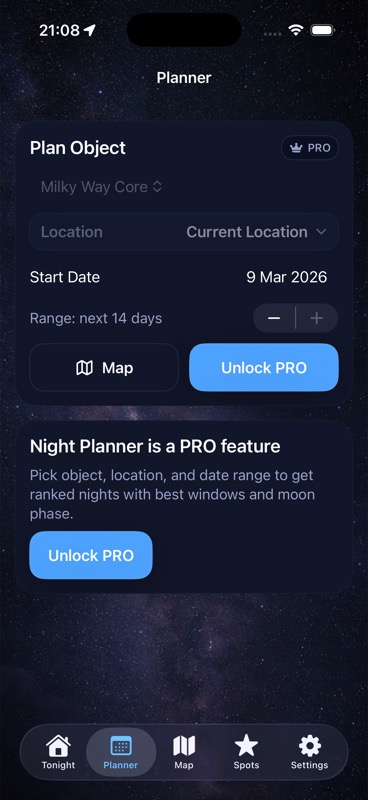
The Planner screenshot above illustrates night planning. The current App Store listing describes the free iPhone app, requiring iOS 26 or later.
Plan the watch. Keep the count.
Compare the night's conditions, then open the counter in the current Leonids guide for a timed personal count.
Get DarkScout for iPhone All features free · iOS 26 or laterSources and further reading
- Astronomical League: Visual Form Instructions — timing, breaks, and cloud obstruction in the watched field.
- IMO: Visual Observations — recording time and limiting-magnitude estimates.
- IMO: Minor Showers Observations — field changes, association criteria, and learning with total-only records.
- BAA: Visual Observing — time labels, recording methods, attention, and honesty.
- AMS: Meteor FAQ — standardized rates and actual viewing conditions.