Planning a moonrise photo with a foreground is different from simply knowing when the moon rises. The useful question is where the moon will appear from your exact shooting position, how high it will be when it clears the foreground, and whether the light and weather still support the image by then.
The best plans start with the final composition. Decide what the moon should relate to: a ridge line, a tower, a tree, a skyline, a rock arch, or a person on a hill. Then work backward from that foreground to choose a camera position, lens, timing window, and fallback plan.
The short version
To plan a moonrise photo with a foreground, choose the foreground first, stand far enough away for the moon to appear large, check the moon's rise direction and altitude, arrive before the alignment, and protect yourself from low-horizon cloud. The strongest image usually happens minutes after the listed moonrise time, not exactly at it.
That is because published moonrise time usually describes when the moon crosses the mathematical horizon. Your real horizon may be a ridge, building, tree line, or haze layer. If the foreground sits above the true horizon, the moon may not appear in your frame until later and at a different altitude than expected.
Start with the foreground, not the moon
A full moon rising into an empty frame can be beautiful, but foreground is what gives the photograph a reason to exist. Pick a subject with a clean silhouette, recognizable shape, and enough space around it that the moon can sit beside, above, or behind it without feeling cramped.
Look for foregrounds that remain readable from a distance. If the subject only works from ten meters away, the moon will look small behind it. If it still has a strong shape from hundreds of meters or more, you can use a longer lens and compress the scene so the moon feels more intentional.
Distance controls moon size
The moon's apparent size in the sky barely changes during the night. What changes in a planned moonrise photo is the relationship between the foreground and the moon. Standing farther from the foreground lets you use a longer focal length, which makes the moon occupy more of the frame relative to the subject.
This is why many dramatic moonrise images are made from farther away than beginners expect. A nearby tree with a wide lens makes the moon look small. A distant tree, ridge, or building photographed with a telephoto lens can make the moon feel much larger while keeping the foreground sharp and recognizable.
Check direction and altitude together
Direction tells you whether the moon lines up left-to-right with the foreground. Altitude tells you whether it is high enough to clear the real horizon and land in the part of the composition you want. You need both. A perfect azimuth at the wrong altitude can still put the moon behind a ridge or too high above the subject.
Build a small timing window around the alignment. Note when the moon is just below the foreground, when it touches the edge, when it sits where you want it, and when it becomes too high. For tight telephoto compositions, that useful window can be short. Arrive early enough to refine tripod position before the moon reaches the mark.
Twilight changes the mood
A moonrise near sunset or during civil twilight can keep color and detail in the foreground. A later moonrise may give you a darker, cleaner silhouette but less landscape information. Neither is automatically better. The choice depends on whether the foreground should be a subject with detail or a graphic shape against the sky.
If the moonrise happens during nautical twilight, you may have a strong balance: enough sky color to hold the scene, enough darkness for the moon to feel bright, and enough ambient light to work the composition. The tradeoffs are similar to the ones in the astronomical darkness vs nautical twilight guide, except the foreground is part of the plan instead of a setup chore.
Moon phase is a creative decision
Full moon gets the attention because it rises around sunset and looks bright against the evening sky. But it is not the only useful phase. A nearly full moon can rise a little earlier or later, changing the sky brightness and giving you a different balance between foreground detail and moon contrast.
Crescent and gibbous moons can also work when the shape matters more than size. The key is to choose the phase for the photograph you want, then check whether the timing still aligns with your foreground. The broader tradeoff between brightness, target choice, and sky contrast is covered in the moon phase astrophotography planning guide.
Clouds near the horizon are the real risk
A general cloud forecast can look acceptable while the exact moonrise direction is blocked by a low bank of cloud. Moonrise photos are vulnerable because the important moment often happens close to the horizon, where haze, distant cloud, and terrain have the most leverage.
Do not only ask whether the whole sky is clear. Ask whether the horizon in the moonrise direction is likely to stay open during the ten or twenty minutes that matter. If the plan depends on one precise alignment and the horizon forecast is marginal, choose a foreground with more tolerance or keep a second camera position ready.
A field checklist for moonrise alignment
Before leaving, write down the foreground, the intended camera position, the lens range, the moonrise direction, the useful altitude range, and the expected alignment time. On site, confirm the real horizon, level the tripod, make a test frame without the moon, and leave room to move a few meters if the line is slightly off.
Exposure is its own balancing act. The moon is bright, the foreground may be dark, and the sky can change quickly during twilight. Bracket important frames if the contrast is high, and avoid spending the short alignment window buried in settings. Your composition and timing will matter more than one perfect test exposure.
Plan moonrise like a moving alignment, not a single timestamp. Direction gets you close, altitude makes it real, and distance decides whether the moon feels deliberate in the frame.
When to skip the drive
Stay home or pick a simpler subject when the moonrise direction is uncertain, the foreground has no clean shape from the planned distance, the useful window is shorter than your setup time, or low clouds are likely in the only direction that matters. Moonrise plans are rewarding, but they can be brittle.
A better fallback is often a wider composition, a different foreground, or a scouting trip without the pressure of making the final image. The same thinking applies when choosing dark locations: a useful spot is not just dark or scenic, it has repeatable access, a clear horizon, and a composition that works when the sky event actually arrives. That is why location quality matters in dark sky location scouting, too.
Where DarkScout fits
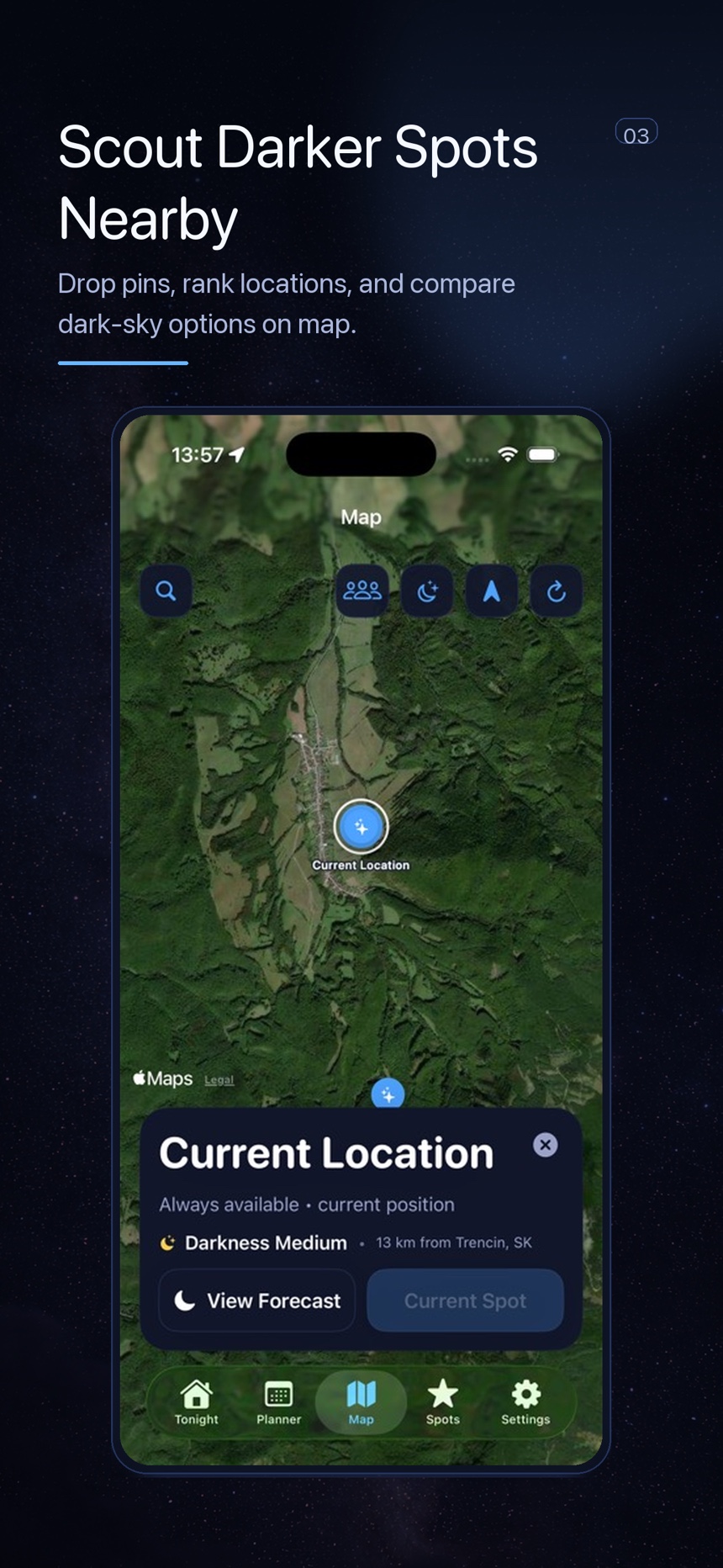
DarkScout helps keep the moonrise plan tied to the rest of the night instead of treating alignment as the only variable. Use it to compare moon impact, cloud context, darkness, and saved spots before you commit to the drive, then use your on-site checks to fine-tune the final meters.
The goal is a plan that survives reality. When the foreground, timing, direction, elevation, and weather all agree, a moonrise photograph starts to feel less like luck and more like a session you deliberately built.