
A record you can reconstruct is more useful than an unexplained number. The procedure below follows the International Meteor Organization's method; its linked charts and conversion table are part of the procedure.
Know what you are estimating
The National Park Service's metrics guide defines naked-eye limiting magnitude, or NELM, as the magnitude of the faintest star visible without optical aid. It depends on the observer and dark adaptation as well as the sky. A larger stellar-magnitude number denotes a fainter star.
Treat the result as a dated personal observation. Keep a private site reference in your notes, and attach each new session to that reference. This makes a later comparison possible without publishing a precise location.
Prepare the references and notes before going out
Open the official instructions while you have time to read them. Save or print the needed references, check that they remain legible, and keep the source URL with your record. Resolve unfamiliar chart symbols before the session rather than trying to learn the whole procedure while watching the sky.
Use the phone and observing-light checklist to prepare your lighting routine. Write a clear date and time basis on the notes; the night-sky time-zone guide covers overnight dates and clock changes.
Follow the IMO star-count method
IMO's detailed instructions use slightly averted naked-eye viewing:
- Choose at least two, preferably three, official fields in your observing direction, each above 40° elevation.
- Identify their boundaries using Table 1 and its linked charts.
- Count visible stars, including the corner stars, with your ordinary observing attention. Record the time, field number, and count.
- Convert each count with that same field's column in Table 2. A constellation name alone does not define the area.
- Keep the individual results. Read the table’s large-gap warning and the nearby Milky Way caveat before accepting a value.
Make an estimate at the start, then repeat every 30–45 minutes. Do not replace your own estimate with another observer's value.
Record changes during the session
IMO's visual-observing overview calls for more frequent estimates when twilight, clouds, dust, moonlight, or other effects change viewing conditions.
Give a changed condition its own dated entry. Keep the previous entry instead of overwriting it: a later review should show which part of the session each note describes. Separate what you noticed from a cause you have not established.
For a meteor watch, keep these notes with the meteor observing log. The visibility estimate supplements the record of actual watching time, interruptions, and counts; keep those records connected.
Resolve an incomplete estimate
| What is uncertain | Useful next action |
|---|---|
| You cannot reconstruct which chart you used | Mark the result provisional and locate the reference before interpreting it. |
| The notes contain a disputed observation | Retain that uncertainty; make a fresh entry rather than silently changing the original. |
| A reference is unreadable in the field | Leave the interpretation pending until you can consult it properly. |
| A session has no usable observation | Write unknown. Keep the planning information in a separate part of the record. |
Copy this field record
This is a blank personal record, with no claimed observation or example result. Add a new entry for each check.
- Identity: observer label, private site reference, date, and time basis.
- Method: source URL and reference copy used.
- Per field: time, field number, star count, table result, and uncertainty.
- Context: conditions noticed and any change since the previous entry.
- Review: interpretation completed or pending, unresolved questions, and next check.
Retain the raw entry with its interpretation. If a later correction is needed, annotate the reason and preserve the earlier note so that the change remains understandable.
Compare the same kind of evidence
The Sky Quality Meter manufacturer's FAQ distinguishes a star's magnitude from sky surface brightness in magnitudes per square arcsecond. It also explains that SQM and SQM-L meters have different fields of view. Keep any instrument reading with its model and measurement procedure.
The NPS guide describes Bortle class as a nine-level classification based on visible sky features. Keep that classification, an instrument reading, and your star-count estimate in separate labeled fields. The different definitions do not justify treating the numbers as interchangeable.
When a map seems inconsistent with your notes, use the dark-sky map evidence guide to identify what the layer represents. Begin a comparison by asking what each record actually contains, then decide whether it answers the same question.
Plan the observing window with DarkScout
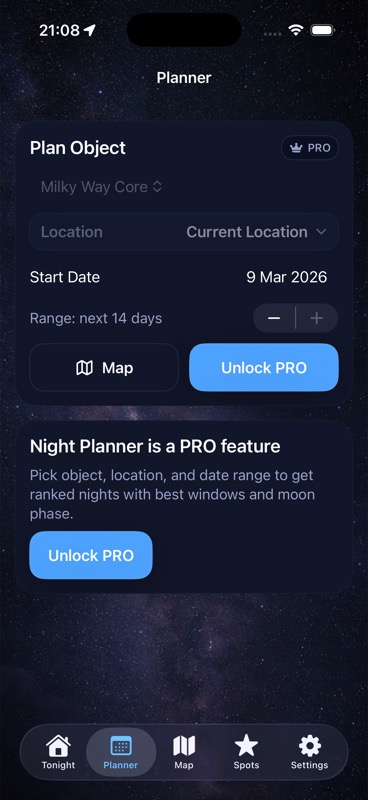
DarkScout brings Moon, cloud, observing-spot, and target-window context into the session plan. Carry out and retain the star-count procedure yourself. The Planner image above illustrates planning; the app's darkness estimate is a heuristic rather than a calibrated NELM or SQM measurement.
The current App Store listing offers the free iPhone app, requiring iOS 26 or later.
Choose a window for your next observation.
Compare Moon and cloud conditions with your observing spot before heading out.
Get DarkScout for iPhone All features free · iOS 26 or laterSources and further reading
Primary observing instructions, metric definitions, and public app information checked November 11, 2026. Original charts and conversion tables remain with their publisher.